On 2 November 2026, L.ID Conference & Digital ID Hub left Lisbon for the first time to run a Cabo Verde digital identity workshop at TECHPARK CV, in Praia. Its official title was Workshop Cabo Verde: Digital Identity & eID. Over four and a half hours, public institutions, banks, technology companies and consultants discussed the identity infrastructure the country has already built and what it still needs to become real services.
Before the workshop, we published a preview with the programme and the role of each sponsor. This recap of the Cabo Verde digital identity workshop covers what happened in the room: what was said in each session, the numbers people kept coming back to and the questions that move on to LisbonID 2027, on 25 and 26 May in Lisbon.
The Cabo Verde Digital Identity Workshop at a Glance
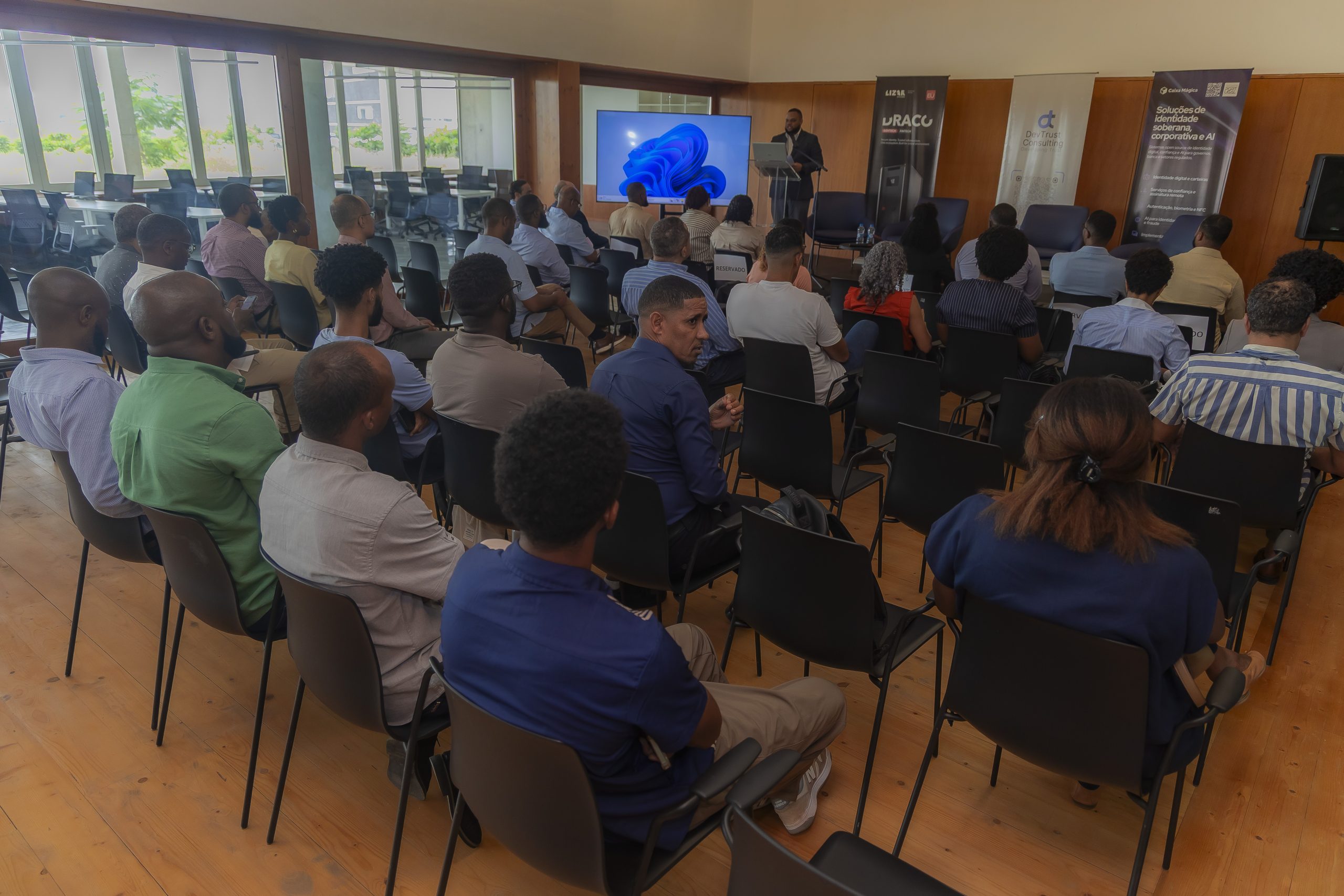
- Date
- Monday, 2 November 2026
- Time
- 14:00 to 18:30
- Venue
- TECHPARK CV, Cabo Verde Digital Archipelago Technology Park, Praia
- Organisers
- L.ID Conference & Digital ID Hub, with Kindness Blossom
- Sponsors
- DevTrust Consulting, LIZAR Systems, Caixa Mágica Software
- Format
- Talks, a panel, open debate, live demos and B2B meetings
Digital Identity and Electronic Identity Are Not the Same
The technical part of the Cabo Verde digital identity workshop opened with IMIJ, Cabo Verde’s Institute for the Modernisation of Justice, on secure identity in the country: the infrastructure that exists today and the challenges of taking it further.
The session began by separating two ideas that are often confused. Digital identity is the set of attributes that represent a person in a digital environment: data, credentials and the context in which they are used. Electronic identity (eID) is an identity guaranteed by a trusted entity and held in documents, certificates or apps.
The difference sounds academic, but it has practical effects. An email account or a social media profile is part of someone’s digital identity. Neither will open a bank account or get you a certificate from a registry. For that, a service needs to know that a reliable record stands behind the person. That record is what eID carries.
Three functions rest on eID:
- Identification. Stating who you are, based on a reliable register.
- Authentication. Proving electronically that you are who you say you are.
- Electronic signature. Signing documents and transactions with legal evidential value.
Each function depends on the one before it. An electronic signature is only worth something if authentication is strong. Authentication is only strong if the first identification was done well. That is why the quality of the base register, which the state maintains, shapes every service that comes after it.
From Authentication to a Complete Service
DevTrust Consulting moved the discussion from infrastructure to services. The underlying question: what changes for citizens when digital identity works from start to finish?
For public administration, the answer was a journey in five steps:
- Authenticate. With Cabo Verde’s Digital Mobile Key, the service already knows who the citizen is.
- Pre-filled data. What the state already knows is not asked for again.
- Information from the source. Through interoperability, with a legal and technical basis.
- Pay or sign if needed. Fees and signatures inside the same process.
- Receive the result. Digitally, with no second trip to an office.
The session also mapped the chain behind that journey. It starts with identity. It moves through data and attributes, which only flow when services can talk to each other. It continues to the act or transaction, where process, signature and payment come in. It ends in a complete digital service. Underneath it all sit privacy, traceability and clear rules on who can access what.
Take a request for a certificate. Today, a citizen may have to gather documents the state already holds, pay at a counter and come back later to collect a paper copy. In the model presented, the citizen logs in with the Digital Mobile Key, confirms data that is already filled in, pays on the same screen and receives a digital certificate. The identity is the same in both cases. Everything around it changes.
Caixa Mágica: Who Is on the Other Side?
At the Cabo Verde digital identity workshop, José Pedro Rodrigues, CEO of Caixa Mágica Software, presented Digital Identity 2030: global trends, standards and new trust models. The title of his first slide summed up the theme.
Who is on the other side? Digital identity in a world where artificial intelligence can imitate anyone. José Pedro Rodrigues, Caixa Mágica Software
The talk pointed to two gaps on the way to 2030. The first affects people who have no identity. The second affects people who do.
Gap 1: absence
About 800 million people worldwide cannot prove who they are. That is one in ten, according to the World Bank. Another 2.8 billion live in economies without a digital identity they can use to authenticate online.
The number has been falling slowly. World Bank figures put it at around one billion people without proof of identity in 2017. By 2021 it was 850 million. In 2025, 800 million. Without a record, a person is shut out of banking, many social benefits and nearly every digital service.
Gap 2: the breach
Where identity exists, verification is being bypassed. The figures came from two industry reports:
- One deepfake attempt every 5 minutes, detected by a single verification provider in 2024 (Entrust). That is 288 a day and more than 105,000 a year.
- A 244% rise in digital document forgeries in one year. They now outnumber physical forgeries (Entrust).
- 40.8% of attacks target national identity cards, the most attacked document (Entrust).
- A 1,151% rise in synthetic video injection attacks on iOS in the second half of 2025, compared with 2024 (iProov).
The last figure needs a word of explanation. In an injection attack, the video never goes through the camera. The attacker feeds an AI-generated video straight into the app, as if it came from the phone. A check that only compares the face with the photo on the document will not catch it. The system also has to confirm that the signal comes from a real camera and a person who is actually there.
The fact that 40.8% of attacks target national identity cards matters for Cabo Verde too. The national card is the base of the country’s digital identity. The more services accept it, the more it is worth to anyone trying to forge it.
A video call in Hong Kong
The clearest example came from Hong Kong in early 2024. An employee of the multinational Arup joined a video call with the chief financial officer and several colleagues. He knew their faces and voices. All of them were generated by artificial intelligence. He made 15 transfers, worth 25.6 million US dollars in total. The fraud only came to light when he contacted head office through another channel.
There was no forged document and no stolen password. The attackers exploited trust in a familiar face. Tomorrow’s digital identity has to solve that problem: proving that the person on the other side is who they claim to be, even on a video call.
Secure Issuance and DRACO, Live
LIZAR Systems spoke about the other end of the chain: the physical document, which is where many digital identities begin. The talk carried a Made in Africa label, a nod to producing secure documents on the continent itself.
During the coffee break, the demo moved from the slides to the table. Participants watched DRACO, LIZAR’s portable unit, personalise demo cards on the spot. The cards, issued by a fictional country called Dracoland, showed laser-engraved photos and data. Next to it, they tried the L.ID Demo Credential, prepared with DevTrust. The preview describes DRACO in detail.
Banking, the Ecosystem and the Panel
The programme included Banco de Cabo Verde on digital identity, trust and innovation in the financial system. For banks, a reliable digital identity lowers the cost of opening accounts and of meeting anti-money laundering rules. It also opens the door to customers who are left out today.
Eng. Hélio Varela brought the ecosystem view: what it takes for identity solutions to be built and maintained in the country, so that Cabo Verde can export that know-how to the region.
The panel that closed the Cabo Verde digital identity workshop, moderated by Eng. Carlos Pina, started from one question: from credential to service, where can digital identity create value today? An open debate followed, with several questions and comments from the audience. The afternoon closed with a cocktail, networking and B2B meetings.
What the Cabo Verde Digital Identity Workshop Leaves for LisbonID 2027
Five ideas ran through the Cabo Verde digital identity workshop. All of them will be on the table in Lisbon.
- Plan issuance and acceptance together. A secure document is worth little if services cannot read it. A digital service is worth little if the document behind it is weak. Programmes stall when the two ends are designed separately.
- AI fraud has reached identity documents. Checking the document is not enough. Services must confirm that a real person is on the other side and that the video comes from a real camera.
- Citizens feel the complete service. Authentication is invisible when it works. What people remember is not having to go back to the counter.
- Interoperability matters for the diaspora. Many Cabo Verdeans live in Portugal and other European countries. A credential issued in one country must be accepted in another. The European Digital Identity Wallet makes this more urgent.
- Inclusion is still unfinished. With 800 million people lacking proof of identity, the most advanced technology does not help someone who was never registered. Civil registration is still the first step.
The link with Cabo Verde did not start with this digital identity workshop. NOSi attended the first LisbonID in May 2026. The second edition, on 25 and 26 May 2027 at Fundação Oriente, will pick up these topics with governments, banks and technology providers from both sides of the Atlantic.
Organisations that want to speak or sponsor in Lisbon can leave their details on the interest form.
Frequently Asked Questions
When and where did the Cabo Verde digital identity workshop take place?
On 2 November 2026, from 14:00 to 18:30, at TECHPARK CV in Praia.
Who organised the Cabo Verde digital identity workshop?
L.ID Conference & Digital ID Hub, with Kindness Blossom. The sponsors were DevTrust Consulting, LIZAR Systems and Caixa Mágica Software.
What topics were discussed at the Cabo Verde digital identity workshop?
Digital and electronic identity in Cabo Verde, end-to-end public digital services, trends to 2030, deepfake fraud, secure document issuance and identity in the financial system.
What is the difference between digital identity and electronic identity?
Digital identity is the set of attributes that represent a person online. Electronic identity (eID) is an identity guaranteed by a trusted entity such as the state. It is used to identify, authenticate and sign.
What is an injection attack?
An attack in which an AI-generated video is sent straight into a verification app without going through the camera. It fools systems that only compare the face with the document photo.
When is the next LisbonID?
On 25 and 26 May 2027, at Fundação Oriente in Lisbon.
- World Bank, ID4D Global Dataset 2025. id4d.worldbank.org
- Entrust, Deepfake attacks strike every five minutes amid 244% surge in digital document forgeries (2025 Identity Fraud Report). entrust.com
- Biometric Update, Biometric injection attack surge spreads to iOS: iProov report, April 2026. biometricupdate.com
- South China Morning Post, UK multinational Arup confirmed as victim of HK$200 million deepfake scam, May 2024. scmp.com
- NOSi, Cabo Verde Digital Mobile Key. nosi.cv
- L.ID Conference & Digital ID Hub, official workshop programme, October 2026. lid-event.com